lunedì 20 ottobre 2014

Christian Circuit 13/ La Basilica di Sardhana e la regina guerriera


Sardhana, 20 October 2014

The Church of Sardhana, the largest in North of India, has a fascinating history. It was built in the 18th century by Begum Samru, a Muslim lady who married a European mercenary soldier, Walter Reinhard Sombre, and became the only Catholic ruler in India after the death of the husband.
The church is dedicated to Our Lady of Graces and it is one of the 19 basilicas in India.

The architect is an Italian military engineering, Antonio Reghelini, from Padua, who was at the at the service of the Begum. The construction was started at 1809 and was completed on 1820. According to a Latin inscription over the main door it was dedicated in 1822. He took inspiration to different churches built in Italy. The Roman domes, a large one over the sanctuary and the two smaller, are similar to the one of S. Peter's basilica in Rome with a touch of Palladio.
The facade is on the Western side (because according to the tradition the altar is towards the rising of the sun) and so it is not visible when you enter the gate from the North side. Eighteen Doric pillars compose the veranda.

The Tomb of the Begum Inside, on the left of the main altar, there is the tomb of the Begum, a 18 feet marble monument of the Italian sculptor Adamo Tadolini of Bologna, one of the best disciples of Canova.
It was erected in 1870 after being commissioned by David Dyce Somru, the adopted son of the Begum. This eighteen foot Carrara marble complex consists of eleven life size figures and three pale in bas-relief. The six figures below, around the panels, are symbolic. While the other four immortalise persons that were intimately connected with the Begum at the time of death.
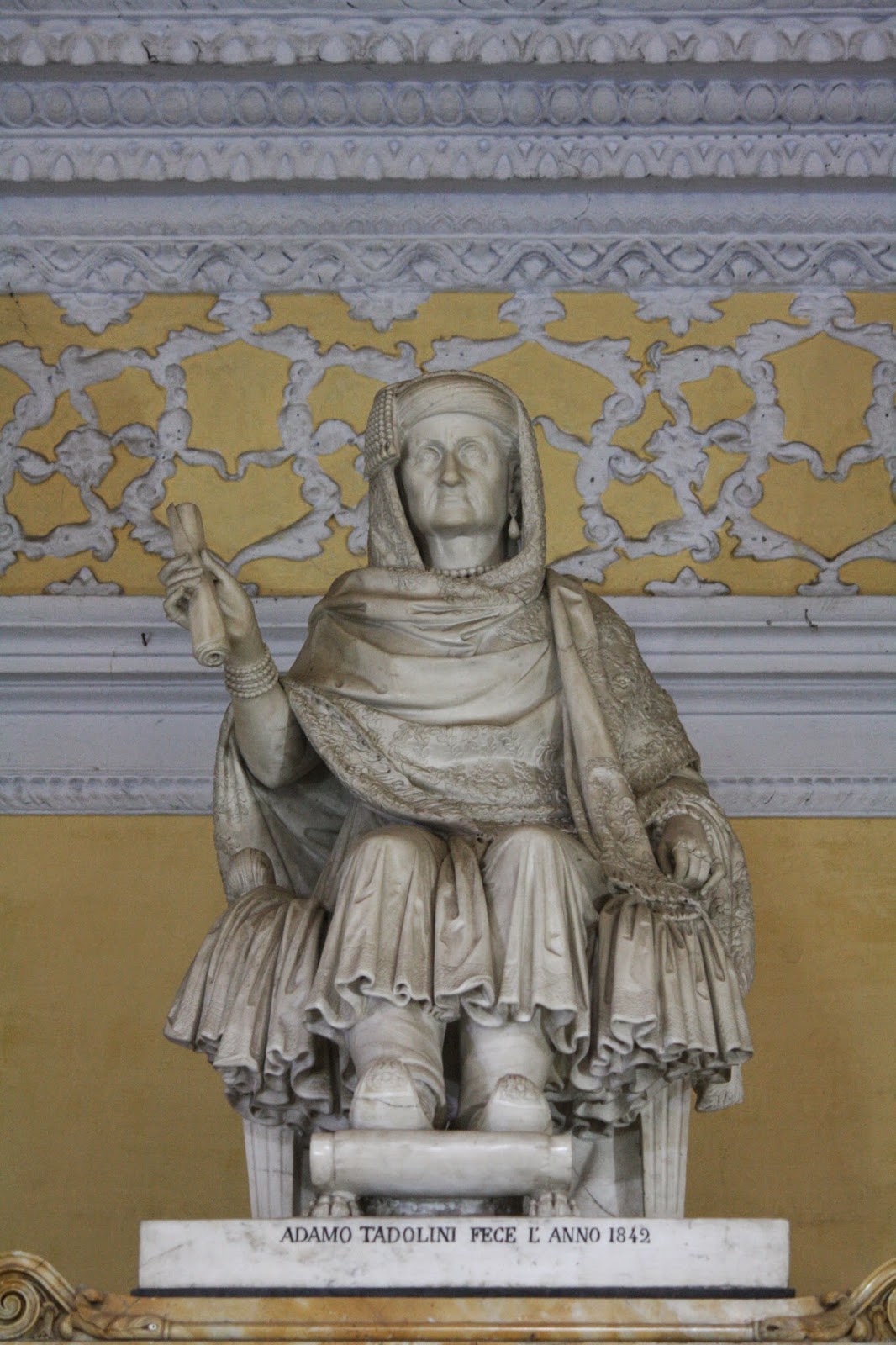
Right on the top the Begum, who died in 1836 at the age of 85, sits in a throne holding in her hand the scroll of Moghul Emperor Shah Alam I conferring on her the 'jagir' of Sardhana after the death of the husband. In the panel below the queen is smoking the hookah with Europeans and Indians in audience. Standing below, to her right, is her adopted son David Dyce Sombre. To her left is minister Diwan Rae Singh, Motilal Nehru's great grandfather. The inscription is in Arabic, Latin and English.

Farzana 'Begum Somru', the warrior queenFarzana was the daughter of Latif Ali Khan, a nobleman of Arabian origin who settled near the towan of Meerut. After the death of the father, she became a dancer. At 15 years old she met a French official Walter Reinhard, a mercenary who was at the service of the raja of Bharatpur. They did not have children.
She decided to convert to the Catholic religion on 7th May 1781, three years after the husband death and she took the name of Joanna, probably inspired by Joan of Arc.
During the 58 years of her life after the conversion, her faith remained strong and also her desire to build churches. Also her step son, Zafar Yab Khan was also baptised taking the name of the father Walter Balthazzar Reinhardt.
She was always loyal to the Mogul emperor Shah Alam and she helped him to fight rebels and enemies at the door of Delhi. She also saved his life on the battle field. The Emperor conferred on her the title of 'Zeb ul Nisa', the 'jewel of her sex'.
In the 1790 she married a young French, Le Vaisseu, but the love story of the Begum created scandal and discontent among the European officials. The situation led to a lot of unrest and ultimately at a mutiny. The husband was killed and she was captured and kept prisoner until she was rescued by other officers who remained loyal to her.
Afterward, with the rising of the British power, she used her political influence to deal with the new dominator and signed a treaty. Since there the kingdom of Sardhana was in peace and became prosperous.

GraveyardIt is under the care of the Archaeological Department, but it is in a state of decay. In the centre is the family tomb of descendants of the Begum. Here lies buried Julie Anne, daughter of Louis Balthazzar Reinhardt, Somru's son and mother of Dice Somru, the adopted son of the Begum.
As you enter the cemetery, close to the path on the left, is the grave of Le Vaisseau, her French lover who married and who was killed during a revolt of his army. The inscription on the red sandstone slab is the following ‘Priez Dieu pour son ame: requiescat in pace: 15 october 1795'.

To the right of the path, there are a number of pyramidically shaped tomb stones belonging to the family of Reghelini, architect of the church and palace.

How to arriveSardhana is after Meerut in Uttar Pradesh. Along the road to Muzaffanagar, Roorkee and Dehradun turn left and drive for 22 km. The church is outside the city center and in a green field.
The old graveyard is on the other side of the town on a road that passes in front of the bus stand. When you see a temple turn left in a small street. After 200 meters there is the gate. If it is closed, ask for the custodian to open it.

venerdì 14 febbraio 2014

Christianity Circuit 11/Mahe - Chiesa Santa Teresa nell'ex colonia francese

Mahe, ex colonia francese, sorge sulla costa settentrionale del Kerala tra Calicut e Kannaur. In lingua malayalam si chiama Mayyazhi che vuol dire lo “sbocco del fiume nero”. Fa parte del territorio di Pondicherry, che pero’ e’ a oltre 600 chilometri di distanza sulla costa orientale indiana. Faceva parte dei cosiddetti “Établissements français dans l'Inde” insieme a Karikal, Yanaon (Coromandel Coast) e Chandernagor (West Bengal).
La presenza francese in questo ex villaggio situato su un estuario del fiume omonimo Mahe’ risale al 1724 ed e’ legata al commercio delle spezie. Dopo aver stretto un accordo con il maharaja locale (Raja Vazhunnavar of Badagara) la French East India Company rappresentata da un certo Andre’ Mollandin, costrui’ un forte. Ma nome di Mahe’ e’ dovuto al capitano francese Mahe de Labourdonnais che la riconquisto’ dopo alcuni anni.
Oggi non e’ rimasta alcuna traccia del passato francese perche’ la citta’ fortificata venne rasa al suolo durante le tante battaglie con gli inglesi. Da mappe antiche emergono che c’erano diversi forti che sono anche stati identificati e studiati (Vedi qui)
Gli inglesi la catturarono nel 1761, ma poi la ricedettero ai francesi dopo il Trattato di Parigi del 1763. Dopo cinque anni ci fu una nuova guerra e la Francia perse nuovamente la sua colonia. Nel 1758 Mahe ritorno’ nelle mani dei francesi ma solo per poco perche’ furono sconfitti nel 1793 nella terza guerra con i britannici. Dopo Napoleone, nel 1814 la colonia venne restituita di nuovo alla Francia in seguito al nuovo trattato di Parigi.
Durante il raj britannico e anche per alcuni anni dopo l’Indipendenza indiana riusci’ a sopravvivere come colonia francese. Nel 13 giugno 1954 fu “liberata” dal dominio francese e annessa all’Unione Indiana.

La chiesa cattolica di Santa Teresa d’Avila non e’ quella originale, ma si pensa che sia nello stesso posto del santuario sorto nel 1736, in contemporanea con l’arrivo dei francesi. Si dice che sia stata costruita da un missionario italiano, “Dominic of St. John of the Cross”, che giunse qui con i francesi.
E’ considerata come una delle piu’antiche chiese cristiane del Kerala.

C’e’una leggenda sulla sua origine. Sembra che un galeone con a bordo una statua di Santa Teresa si fosse improvvisamente fermato davanti al villaggio di pescatori e che cio’ era stato visto come un segno divino. Soltanto quando l’effige della santa e’ stata portata a terra, l’imbarcazione si e’ mossa. Nel punto dello sbarco sarebbe stato eretto un santuario in suo onore.
L’attuale edificio e’ stato ristrutturato nel 1956 e restaurato nel 2010. La campana e’ stata posata nel 1855.
Dal 5 al 22 ottobre si tengono solenni festeggiamenti in onore di santa Teresa che attirano numerosi devoti, anche non cristiani.

Come arrivarci:
Mahe e’ sulla statale N17, vicino a Thalassery, e si puo’ arrivare in autobus da Kozhikode (Calicut) o Kannaur.

mercoledì 29 gennaio 2014

Christianity Circuit 10/ Gujarat- Le Tombe olandesi di Ahmedabad


Oltre a Surat, anche Ahmedabad aveva dei rapporti commerciali con l’Olanda fra il 1600 e 1700. La Dutch East India Company era stata creata nel 1602 ed è considerata la prima multinazionale al mondo.
I mercanti olandesi venivano in India a cercare tessuti di cotone e il colorante indaco. Molti si sono stabiliti in maniera permanente e l'unica traccia della loro presenza sono i cimiteri. 

Le tombe olandesi si trovano su una altura vicino al lago di Kankaria. Alcune sono con cupola, altre sono di forma piramidale o chiuse da un recinto, mentre la maggior parte sono semplici lapidi con iscrizioni in latino e olandese.

Del sito, che presenta segni di degrado ed ed è deturpato da graffiti, si sta occupando il governo olandese con un progetto di risistemazione.


Come arrivarci: bisogna entrare nel piccolo “One Tree Hill Garden”, un giardino pubblico che sorge vicino al lago di Kankaria, un bacino artificiale costruito da un sultano per le abluzioni sacre nel XV secolo e ora trasformato in un parco divertimenti con giardino zoologico e altre attrazioni.      

lunedì 30 dicembre 2013

Christianity Circuit 9/ Panjm, la "nuova Goa"

Panajin o Panjim e’ dal 1961 il capoluogo dello stato indiano di Goa e dal 1843 e’ stata la capitale del “Estodo do India”, il dominio coloniale portoghese che si estendeva dal capo di Buona Speranza fino alla Cina e Giappone). Prima di allora era solo un villaggio di pescatori alla foce del fiume Mandovi , la porta di ingresso della “vecchia Goa” del 1700 e 1600, nell’epoca d’oro dell’impero portoghese.
I quartieri di Fontainhas e Sao Tome’ sono i piu’ antichi e dove sorgono le due presenze cristiane piu’ importanti.

Our Lady of Immaculate Conception
Sorge nel quartiere portoghese di Fontainhas ed e’ il simbolo del centro storico di Panjim. Era originariamente una delle sei cappelle (ermida) costruite nell'allora villaggio di Panjim prima del 1541 quando la capitale del dominio portoghese era ancora la vecchia Goa.  Sorge su una collina chiamata Oiteiro e fu ricostruita interamente nel 1619. Era un punto di passaggio dei mercanti che risalivano il fiume Mandovi per andare alla vecchia Goa.
Quando i portoghesi hanno trasferitola capitale nella “nuova Goa” nel  1843 la collina e’ stata tagliata per fare spazio a una strada e sono state costruite le imponenti scale che vediamo oggi e che sono modellate su quelle diOur Lady of Remedios in Lamego. E’stato inoltre abbandonato un cimitero che esisteva sulla collina.
La campana, 2.250 chili,  proviene dal convento di Sant Agostino, nella vecchia Goa,  e per sistemarla e’ stata costruita una nuova torre centrale piu’ alta alterando la facciata originaria della chiesa.

Capella San Sebastiano
Sorge in una piazzetta circondata da edifici in stile coloniale ed e’ stata costruita nel 1818. E’ famosa perche’ ospita il cosiddetto ”crocifisso dell’Inquisizione”  poveniente dalla vecchia Goa, la capitale dei domini orientali del regno portoghese.

Il Cristo in croce ligneo, a dimensione naturale,  ha gli occhi aperti e si dice che e’ stato creato in questo modo per terrorizzare eretici e peccatori che finivano davanti al temibile tribunale portoghese.  L’Inquisizione e’ cessata nel 1814 in seguito a un trattato anglo-portoghese. Il crocifisso e’stato portato prima nel palazzo del Secretariato e poi questa cappella (costruite su rovine di un tempio indu’, sembrerebbe). Ogni anno a meta’ novembre si tiene una processione in onore della Nostra Signora della Liberazione.  

mercoledì 9 ottobre 2013

Christianity Circuit/8 - La Chiesa di St James a Baroda

Baroda, 10 Ottobre 2013
 

La presenza cristiana in Gujarat risale agli inizi del XVII secolo quando sono arrivati i missionari protestanti insieme alla Compagnia Orientale delle Inde. Erano i cappellani delle navi che trasportavano i commercianti. Ma e’ solo nel 1814 che si insedia un vescovo a Calcutta, la capitale del protettorato inglese in Asia. E’ Thomas Fanshawe Middleton e la sua giurisdizione era sull’India, Sri Lanka e Australia.
   La presenza dei cappellani favorisce ovviamente la costruzione di chiese e l’incremento di religiosi. La sede principale (‘’Anglican Chaplain’’) e’ Surat, il primo porto dove gli inglesi sono barcati. Il primo cappellano di Baroda, Henry Jeffereys, e’ stato nominato nel 1818.
    Baroda o Vadodara e’ nota come la capitale culturale dello stato del Gujarat. Era una’’British Residence’’, quindi un centro di affari molto importante per gli inglesi.
    La chiesa anglicana di San James risale al periodo coloniale britannico ed e’ la piu’ antica del Gujarat insieme a quella di Surat e quella Kheda, quest’ultima in rovina. Tutte e tre sono state consacrate nel 1825 dall’arcivescovo di Calcutta Reginald Heber.
    E’ nota anche come ‘’White Church’’. Sorge nel quartiere di Fatehgunj, dove ci sono diverse scuole e la principale universita’. Nei pressi c’e’un santuario di una Madonna.
    E’ stata voluta dall’arcivescovo anglicano di Bombai, George Barnes che ha deciso la costruzione delle tre chiese in Gujarat, ma e’ stata consacrata dal suo successore.
    E’ dedicata a James Sutherland Esquire (1790-1840), il ‘’commissario politico’’ del governo britannico in ‘’Guzerat’’ e ‘’residente’’ alla corte dei maharaja di Baroda, i Gaekwads (‘’Guicowards’’).
   Nel 2000 e’ stato celebrato il 175esimo anno dalla consacrazione come mostra una iscrizione su un piedistallo di cemento nel giardino.
    La chiesa e’ in stile gotico-indiano con una serie di arcate e contrafforti su un lato. Ma ha un tetto molto basso. E’ bassa e priva di campanile. Su un lato ci sono iscrizioni in ricordo di familiari di Sutherand Esquire. Non ci sono tombe. E’ circondata da un grande giardino.

Come arrivarci: il quartiere di Fatehgunj e’ molto popolare per la presenza della Maharaj Sayajirao University of Baroda e di altri istituti scolastici. Ci sono anche altri luoghi religiosi. La chiesa sorge in un quartiere residenziale accanto al santuario di Our Lady of the Forsaken (Jeevan Darshan, 5 Camp ).


domenica 29 settembre 2013

Christianity Circuit/7 - Shekhawati, l'affresco di Gesu Cristo

Nawalgarh, 6 settembre 2013

La regione dello Shekhawati, nello stato del Rajasthan, a sud-ovest di New Delhi, e' famosa per le ''haveli'' (ville dei mercanti) interamente affrescate con soggetti religiosi, scene erotiche e curiose immagini delle ''scoperte'' dell'Ottocento come l'aereoplano o il telegrafo.  La ricchezza del posto e' dovuta al fatto che si trovava su una delle ''vie della Seta'' dai porti del Gujarat  verso il resto dell'Asia.  Stiamo parlando del 1300-1400 prima della venuta dei grandi porti di Calcutta e Mumbai. I commercianti, i ''marwari'', avevano fatto  una fortuna anche come prestasoldi ai ''rajput''.
Da quanto ho capito, cosa rara in India, e' sorto una specie di Rinascimento urbano. I ricchi uomini d'affari hanno iniziato a commissionare gli affreschi a degli artisti da fuori, i quali poi hanno creato delle scuole di pittura per giovani allievi. Sembra che i pittori si siano ispirate a tecniche di pittura usate in Toscana.
Le principesche ''haveli'' facevano quindi a gara ad avere le piu' belle decorazioni. Quando i mercanti se ne sono andati a Calcutta e Mumbai hanno continuato a spedire a casa i soldi alle famiglie che erano rimaste e cosi' la tradizione e' continuata fino - penso - alla partenza degli inglesi.  Ora le haveli sono abbandonate e l'atmosfera e' quella di una eta' dell'oro perduta di cui rimangono i segni, sempre piu' sbiaditi sui muri.
Tra le stravanganze dei pittori, che erano anche muratori e architetti, c'e'  un imagine di Gesu' Cristo sulla haveli Morarka di Nawalgarh, trasformata in un museo da un filantropo dell'etnia ''marwari''   che ha anche fondato una ong per la ricerca nell'agricoltura. Ogni anno organizza un famoso festival.
Nel cortile interno, accanto a divinita' indu, sotto  la balconata, compare anche un'immagine di Gesu' Cristo. Ho letto che e' una delle due immagini del Cristo nello Shekhawati, ma non sono riuscita a capire dove e' la seconda.


giovedì 1 agosto 2013

Christianity Circuit 7/ Vecchia Goa - Pilar Seminary and Museum

Vecchia Goa, aprile 2014

The Pilar hill was inhabited from the very earliest time and the river port at the bottom, Gopakapattana, was a center of trade with Rome.
Some evidences of the early settlement, the Roman period and the hindu rulers of the First Millenium were found in a tank (Chamudeshwari tank) are in the Pilar Seminary Museum.
In the first millennium, after the fall of the Roman empire (476 AD), the trade was taken by a dynasty from Persia.
Many Hindu rulers from Karnataka and Gujarat invaded Goa and gave it to their feudatories.

GOVAPURI, ANCIENT CAPITAL OF GOA
Govapuri, the area around Pilar with the port of Gapakapattana, became the capital of the ruler Shilaras (from 765 to 1020 A.D.). Another dynasty is the Kadambas (960 AD). At the beginning they made Chandrapura (now Chandor) their capital then they move to Govapura after they captured it from the Shilahara.
From the XIV century Muslims took control of Goa who became later a Sultanate.
The Portuguese commander Alfonso de Albuquerque captured Tiswadi (today Old Goa) the 1st march 1510 but fought with the Muslim ruler until November when finally conquered the area after a naval battle.
With the Portogueses,  also the missionaries (most of them Spanish) arrived: Franciscan (1510), Jesuits (1542 with Francis Xavier) and Dominicans (1548).

ORIGIN OF PILAR
Around 1613 the destroyed city of Govapuri got a new Spanish name, Pilar, from the Spanish Our Lady of Pilar in Saragoza. That is why the hillock was discovered by the Franciscans Capuchin from a province of Saragoza. The foundation stone of the Convent was laid in July 17, 1613.
   After 200 years, when the Portoguese suppressed the religious orders (1835) the edifice was abandoned and it was used as a stable for cows. The Portuguese allowed some Goan carmelites to occupy the monastery (1854 to 1887), but then Pilar was in decrepit states.
    In the 1890 the place was assigned to a new missionary society founded in Goa, that took the name of “Society of Pilar”. In the small group there was Agnelo de Souza, who has been declared Venerable by the church and the process of canonization is in process. He died on 19 november 1927.
   Presently Pilar is the hub of educational activities, the Pilar Seminary being an important theological college among them.

THE PILAR MUSEUM
The Pilar Museum is located on the Pilar hillock where the Pilar Seminary (Convento do Pilar) is also located. The Museum was founded by Fr Cosme Jose Costa, and highlights various finds on and around the Pilar hillock and now preserved in the seminary museum. It displays artifacts belonging to all religions - Hindus, Buddhists, Jains, Christians and Muslims.
They relate to the different dynasties and rulers that held sway over Goa, the most important being the Shilaharas and the Kadambas;

ST. THOMAS CROSS IN PAHLAVI LANGUAGE
The artifacts also point out the connection to the Thomas Christians (around 700 AD) and are witness to later Portuguese influences.
An Arab traveler, Ibn Batuta, who in his book "Travels" written in the 14th century in Arabic, reported that he found a Christian settlement on the banks of the river Zuari in Govapuri, the capital of Kadambas of Goa.
The recent find of a Christian Pahlavi Cross of the 7th Century AD confirms that there were Christian settlements in Goa long before the conquest of Goa by the Portuguese.
The finding of this cross in May 2001 by Fr. Cosme Jose Costa, in the banks of the Zuari near Pilar, made worldwide headlines and is now a prime exhibit in the Museum.
The broken cross was found in Dandi (Agasaim), three kilometers from Pilar, hidden in the green. The inscription is in Pahlavi, the language used by the Persian. It is a testimony of the existence of Christians in Goa in very early times. It is believed that Christians were isolated only to Kerala and Mylapore where the apostle Thomas is believed to have come in 53 AD.

The Pahlavi inscription say “My lord Christ have mer(cy) and “the son of Syrian who carried (cut, carved) this cross…”.
Among other interesting artifacts in the museum (all found in Pilar) a seal of the Kadambas, sculptures of Jayakeshi I and Shivachita Parmadideva and his queen Kamala Devi, a Roman amphora, various ancient coins which include two Roman coins and a unique Kadamba gold coin, an eight century idol of Ganesha, a silver gem box dating to Kadamba times, the Khrista Purana (a handwritten Marathi translation of the Bible from 1609), various paintings of Portuguese times etc.

HOW TO ARRIVE:
About 10 km by road from the Old Goa, 12 km from Panaji and 20 km from Margao. It is a big complex on a hillock near the river Zuari.